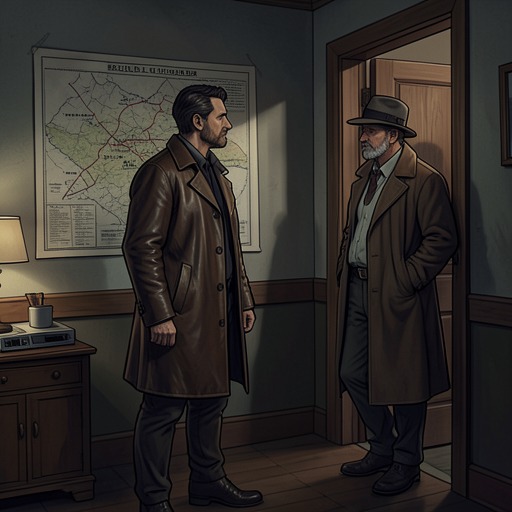
Ernest Burkhart
Killers of the Flower MoonErnest Burkhart was Mollie Burkhart’s husband and William K. Hale’s nephew, a man whose care for his wife sat alongside his obedience to the uncle who orchestrated a murderous scheme against her family. His eventual confession connected the Smith house bombing to Hale, while the route by which the family’s headrights accumulated around Mollie made Ernest’s marriage part of the conspiracy’s financial design.
Identity and Background
Born to a poor cotton-farming family in Texas, Ernest was twenty-eight in 1921. At nineteen he packed a bag and moved to Fairfax, Oklahoma, to live with his uncle, the domineering cattleman William K. Hale. Ernest later described the imbalance between them plainly: “He was not the kind of a man to ask you to do something—he told you.” Hale became a surrogate father; Ernest ran errands for him and, at times, worked as a livery driver. Driving Mollie around town was how the two met.
The account presents Ernest as physically handsome in the conventional style of a Western-film extra, with short brown hair, slate-blue eyes, and a square chin, though his nose seemed to have taken a barroom punch. His habits were less polished: he drank moonshine and played Indian stud poker with disreputable men. Yet his roughness did not preclude tenderness. He learned Osage so he could speak with Mollie in her first language, and cared for her when diabetes left her joints aching and her stomach burning with hunger. When he heard that another man cared for her, Ernest muttered that he could not live without her.
Marriage and Family Life
The relationship crossed social expectations on both sides. Ernest’s roughneck friends mocked him as a “squaw man.” Mollie, although three of her sisters had married white men, felt responsible for entering an arranged Osage marriage like her parents’ union. Her family practiced a mixture of Osage and Catholic beliefs, and she struggled to understand why God would let her find love only to take it away. In 1917, she and Ernest exchanged rings and vowed to love each other until eternity.
By 1921 they had two children: Elizabeth, two years old, and James, an eight-month-old nicknamed Cowboy. Mollie’s aging mother, Lizzie, had moved into their home after Mollie’s father died. Lizzie had once feared that Mollie’s diabetes would kill her young and urged her other children to care for her; in practice, Mollie looked after the family. Ernest’s place within this household would become inseparable from the danger facing it: the family ties that made him Mollie’s husband also gave Hale a route toward the wealth concentrated in her inheritance.
The Family’s Wealth and the Suspicion Around Ernest
As investigators examined the deaths in Mollie’s family, the pattern of inheritance made the succession appear less haphazard. Anna Brown, divorced and without children, left nearly all her wealth to Lizzie. Lizzie directed most of her headright to her surviving daughters, Mollie and Rita Smith. Rita and her husband, Bill Smith, were then killed in the bombing of their home. Their wills stipulated that if they died simultaneously, much of Rita’s headright would pass to Mollie. Bill survived Rita by several days, however, and inherited much of her wealth; after his death, that money went to one of his relatives. Despite this interruption, the bulk of the family’s headrights had flowed to Mollie, whose wealth was controlled by Ernest.
Investigators saw the inheritance trail as a possible indirect channel from Hale to the family fortune through his nephew. An agent described Ernest as “absolutely controlled by Hale,” and informant Kelsie Morrison told agents that Ernest and his brother Bryan did what their uncle ordered. Hale had earlier tried to buy Henry Roan’s headright, but the law prohibited its sale. Investigators suspected that inheritance, rather than a legal purchase, offered a way to capture wealth that the law barred Hale from acquiring directly. The evidence established the pattern and the investigators’ theory; it did not make Ernest’s precise knowledge of every killing self-evident.
Other testimony placed Ernest close to the efforts to manage suspicion around Anna Brown’s murder. Pike told agents that Hale had ordered him to manufacture evidence and false witnesses—to “shape an alibi”—and that Ernest was sometimes present when Pike met with Hale and Bryan. Pike added that Ernest took care never to discuss the case in Mollie’s presence. At a later hearing, an official reminded Ernest that Bryan was the last person seen with Anna. Ernest replied that Bryan said he had left her at home, and called that Bryan’s story. When asked whether he believed it, the available account records the question but not an answer.
Confession and Guilty Plea
The Smith house bombing made the violence against Mollie’s family unmistakable. The blast shattered the house and destroyed the Studebaker, while Mollie and Ernest, awakened by the explosion, watched a distant glow through their window. In the later investigation, Ernest’s role emerged not as that of the bomb-maker but as a link in the chain Hale set in motion.
After agents questioned him, Ernest appeared defeated. He repeatedly came close to confessing but stopped himself. Near midnight, Tom White left him with the other agents and returned to his hotel. Later, an agent called White back: Ernest was ready to tell his story, but would speak only to him. In the interview room, Ernest said he had not killed all the people who had died, but knew who had. He signed a statement acknowledging that he had been warned of his rights and that no immunity had been promised. He then described worshipping Hale as a boy, working for him, and following his orders. Ernest said Hale had shared details of a plan to kill Rita and Bill Smith. When Hale announced that he intended to blow up the house with everyone inside, including his own relatives, Ernest said he protested. Hale answered, “What do you care? Your wife will get the money.”
At trial, Ernest chose to plead guilty rather than continue to deny his part. He admitted that he had carried Hale’s message to John Ramsey, telling him to let Asa Kirby know it was time to blow up the Smith house. Ernest said, “I feel in my heart that I did it because I was requested to do it by Hale, who is my uncle,” and called stopping the trial and acknowledging the truth the honest and honorable thing to do. The judge asked whether federal agents had forced his confession at gunpoint or threatened him with electrocution. Ernest said that, apart from keeping him up late, the agents had treated him well. The judge accepted the guilty plea.
Betrayal and Narrative Significance
Ernest’s account brings the conspiracy’s private and financial dimensions into the same frame. The marriage began in mutual attachment: he learned Mollie’s language, cared for her illness, and built a family with her. Yet the headrights passing through her family made that marriage useful to Hale’s designs, while Ernest’s submission to his uncle placed him between the person he had vowed to love and the man whose orders he had long followed.
His confession clarified one concrete part of the plot—the message that enabled the bombing—without claiming that he personally killed every victim or knew every mechanism Hale used. That distinction matters: Ernest’s testimony both incriminated him and identified Hale as the authority he said he obeyed. The accepted plea ended the trial with Ernest acknowledging a role in the killing of Mollie’s relatives, turning the family’s apparent inheritance into evidence of how intimate trust had been made instrumental to the crime.